


VC Evaluation Vibration Measurement System and Use Cases
Overview
Based on ISO 2631 and the paper Generic Vibration Criteria for Vibration-Sensitive Equipment by Colin G. Gordon (SPIE99), we provide a library for evaluating vibrations in precision equipment (hereafter referred to as the VC Evaluation Library).
By combining the VC Evaluation Library with a vibration measurement system using Raspberry Pi products, you can output vibration levels calculated from accelerometer measurement data.
Additionally you can perform relay control according to vibration levels by using a relay control board.
What is VC Evaluation?
VC evaluation is based on ISO 2631 and the paper Generic Vibration Criteria for Vibration-Sensitive Equipment by Colin G. Gordon (SPIE99). It indicates permissible vibration criteria for precision equipment. These criteria vary depending on the type of equipment.
Installation Guidelines for Target Equipment
| VC Level | Example Equipment |
|---|---|
| A | Proximity projection aligner, optical microscope (400x) |
| B | Stepper (3µm linewidth), optical microscope (1000x) |
| C | Stepper (1µm linewidth), image inspection system (≥1000x) |
| D | Stepper (<1µm linewidth), SEM, TEM |
| E | Semiconductor lithography equipment (nm level), laser interferometer |
| F | Extremely quiet research spaces (difficult to achieve in cleanrooms) |
| G |
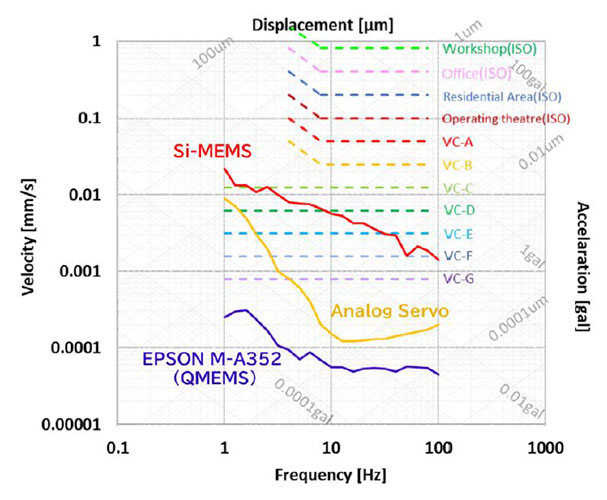
Tripartite Graph
VC levels are determined by calculating the one-third octave band of RMS velocity from measured vibration data. For example, if the vibration peak lies between VC-B and VC-A, the VC level is judged as VC-A.
Using the VC Evaluation Library, you can calculate and output VC levels from accelation.
Use Case 1: Real-Time Warning with Signal Light
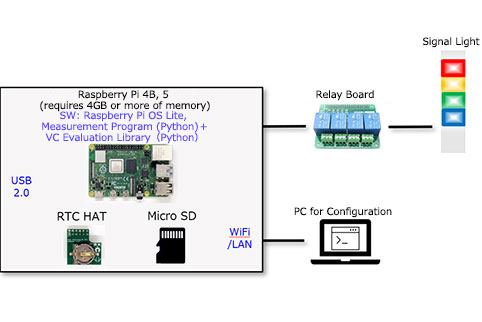
An example application of the VC Evaluation Library is a real-time warning system. By installing a relay control board on Raspberry Pi with the VC Evaluation Library and controlling a signal light, you can create a system where the light turns on according to vibration levels. This system enables continuous vibration monitoring and real-time visualization of vibration levels. To build this system, download the Sample Code and refer to the User Guide provided in this page.
System Configuration Example
Note: This example uses waterproof and dustproof sensors. For embedded sensors, refer to the system configuration example in "Vibration Measurement System and Monitoring App using Raspberry Pi Products."
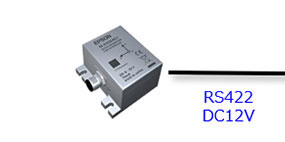
| Accelerometer: M-A552AR10 |
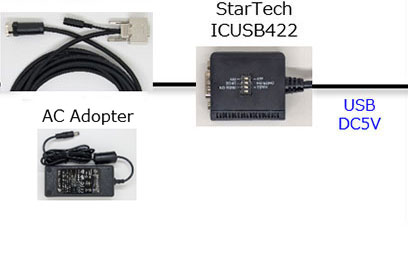
RS422 Cable: KD-002-XXX |
 |
 |
 |
|
| |
Use Case 2: Web-Based Remote Monitoring
The Vibration Measurement System Monitoring App is a web application that displays measurement data on a web interface. Combined with the VC Evaluation Library, users can access Raspberry Pi via a web browser and check VC evaluation graphs in real time.
To build this system, download the Sample Code and refer to the User Guide and the Monitoring App documentation.
Documents
| Documents | Description |
|---|---|
| VC Evaluation Library Reference Manual (PDF, 663KB) | Manual for using the VC Evaluation Library |
| VC Evaluation Vibration Measurement System User Guide (PDF, 695KB) | Guide for using the VC Evaluation Vibration Measurement System. Recommended for building systems in Use Cases 1 and 2 |
Programs
By using the sample code below, you agree to the license terms stated in the source files.
The sample code supports Raspberry Pi 4B and Raspberry Pi 5.
| Programs | Description |
|---|---|
| VC Evaluation Library Source Code (Python) (ZIP, 11KB) | Source code for the VC Evaluation Library. |
| VC Evaluation Vibration Measurement System Sample Code (Python) (ZIP, 123KB) | Source code for the VC Evaluation Vibration Measurement System. Recommended for building systems in Use Cases 1 and 2. |