Drone, Cinema, and Automotive Cameras The Growing
Importance of IMUs in Camera Gimbal Applications
As drone cameras, cinema cameras, and automotive cameras continue to evolve toward higher resolutions and longer focal lengths, even slight vibrations and attitude changes can have a significant impact on image quality and observation accuracy. For this reason, camera gimbals require highly accurate attitude control, and the IMU (Inertial Measurement Unit) is a key component at the core of this function. By measuring angular velocity and acceleration and providing the data required for gimbal stabilization control and pointing control, IMUs help reduce image blur and achieve stable pointing performance. This page explains the performance requirements for IMUs in camera gimbal applications and the reasons behind them, while also introducing key considerations for IMU selection to support stable imaging performance in a wide range of gimbal applications, including drones, mobile platforms, and surveillance cameras.
IMU Requirements and Their Rationale for Camera Gimbal Applications
Requirements for Inertial Sensor Used in Camera Gimbals
- Low noise: Keeps pointing error small to obtain high-quality images and video
- Wide detection range: Supports high-slew-rate pointing control
- Wide bandwidth and low latency: Improves vibration-control responsiveness
- Compact and lightweight: Helps reduce payload size and weight, enabling installation in a wide range of models
- Compatibility: Makes it easier to expand models from high-end to entry-level using a common design
- External trigger input: Facilitates synchronization with cameras, GPS, and other equipment
Features of Epson IMUs
1. High Performance, Compact, and Lightweight
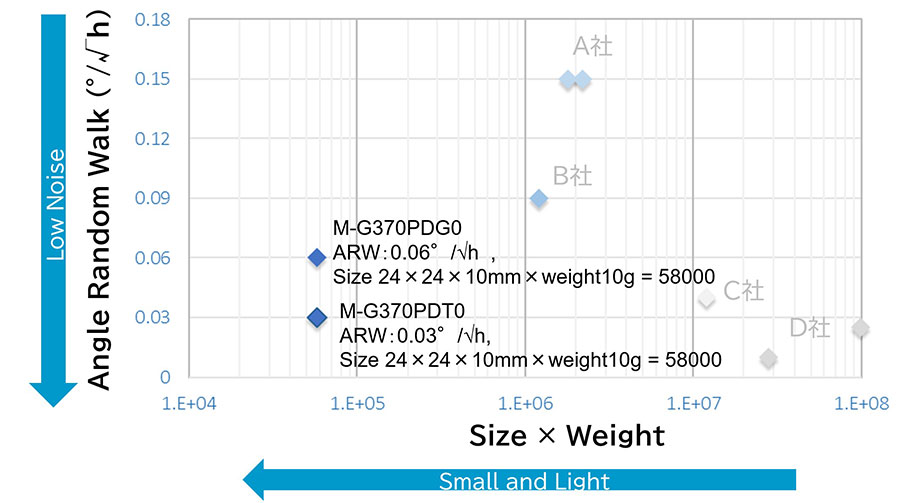
Camera gimbals require high attitude stability within limited space and weight constraints. Epson IMUs combine compact size and light weight with the low-noise performance that is essential for attitude control, contributing to higher performance in gimbal systems.
- Low noise: Angle Random Walk (ARW) of 0.03 °/√h
-
High zero-point accuracy:
- Initial bias error of 360 °/h (gyroscope) and 2 mG (accelerometer)
- Compact and lightweight: 24 × 24 × 10 mm, 10 g
- Wide detection range: Supports ±450 °/s and ±16 G settings
-
Wide bandwidth and low latency:
- Up to 500 Hz, 45° at 150 Hz, down to 830 microsecond latency*1
*1 Calculated based on the measured latency of the M-G366PDG0 at the TAP0 setting.
2. Correction Functions That Support Stable Output in Real-World Environments
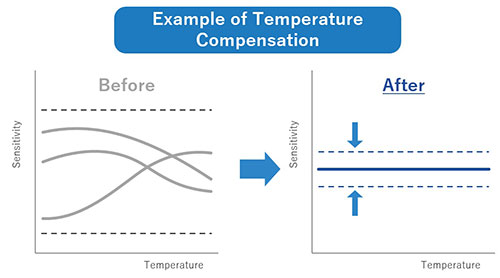
Sensor output may deteriorate due to factors such as mounting-board warpage, mounting error, vibration, and temperature changes. Epson IMUs use a built-in processor to perform various corrections, enabling stable output of high-accuracy sensing data.
- Alignment correction, sensitivity correction, offset correction, and temperature correction
- Filter processing
For Stable Imaging and Pointing in Drones, Mobile Platforms, Surveillance Cameras, and Surveying Cameras
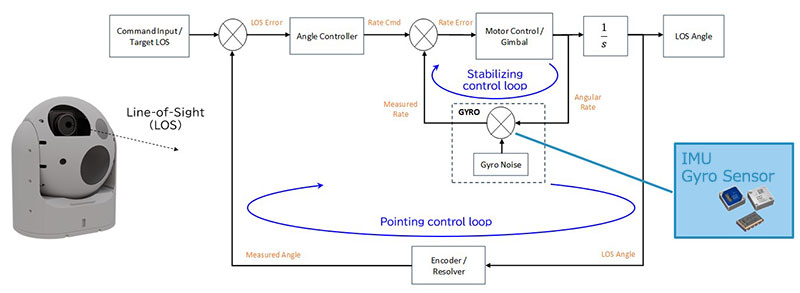
Camera gimbals mounted on drones and other mobile platforms must stabilize the camera direction while tracking platform vibration and attitude changes. By detecting angular rate and acceleration at high frequency with an IMU and inputting this data into the control system, they help reduce video shake, improve tracking performance, and ensure pointing accuracy.
Three Ways Epson IMUs Support Camera Gimbals
- Low-noise performance: Helps reduce minute angular shake, which is critical for telephoto and high-resolution imaging
- Compact and lightweight: Helps save space inside the gimbal housing and payload
- Compatibility: Makes it easier to expand a product lineup, from high-end models to cost-conscious models, using a common design
Recommended Sensors
The following products are recommended for use in gimbal applications. You can select the optimal model according to the application and required performance.
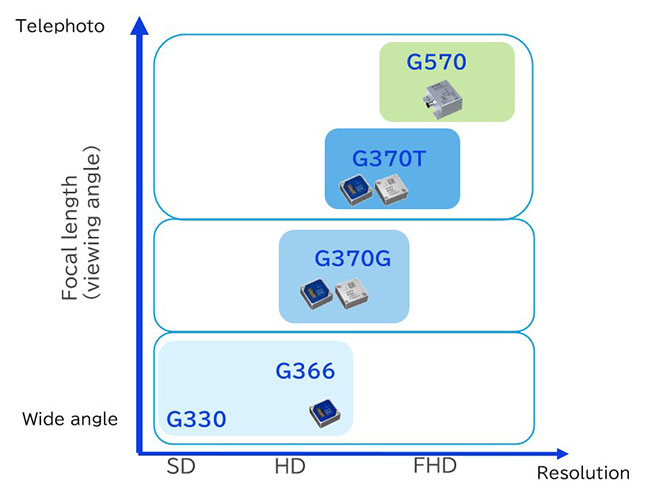
As video resolution increases and telephoto shooting becomes more demanding, gimbals require greater attitude stability.
Epson's IMUs are offered on a compatible common platform, allowing users to select the optimal product based on their performance requirements.
The table below shows representative products recommended for gimbal applications.
Please feel free to contact us for more information.
| ITAR FREE |
Product Name |
Product type | Brief Sheet | Size [mm] |
Weight [g] |
Gyro Sensor | Accelerometer | Misalignment [°] |
Interface | Operating Temp [℃] |
Power Consumption [mA] |
Power Supply [V] |
|||
|---|---|---|---|---|---|---|---|---|---|---|---|---|---|---|---|
| Range [°/s] |
BIS [°/h] |
ARW [°/√h] |
Range [G] |
BIS [µG] |
|||||||||||
| ✔ | M-G370PDT0 | Premium |  |
 24×24×10 |
10 | ±200 | 0.8 | 0.03 | ±8,16*1 | 24 | 0.01 | SPI/UART | -40 to +85 | 16@3.3V | 3.3 |
| ✔ | M-G370PDG0 | Advanced | |
 24×24×10 |
10 | ±450 | 0.8 | 0.06 | ±8,16*1 | 24 | 0.01 | SPI/UART | -40 to +85 | 16@3.3V | 3.3 |
| ✔ | M-G570PR20 | High end | |
 65×65×30 |
150 | ±475 | 0.5 | 0.04 | ±15 | 14 | 0.15 | RS422 | -30 to +70 | 80@12V | 9 to 24 |
| ✔ | M-G552PR80 | Dust proof/Water proof (IP67) |
|
 65×60×30 |
115 | ±450 | 0.8 | 0.06 | ±8,16*1 | 24 | 0.01 | RS422 | -30 to +80 | 38@12V | 9 to 32 |
Contact Us
For product purchases, inquiries, or documentation requests, please contact us via the inquiry form.